What the Listing Price Won't Tell You About Buying Waterfront on Harkers Island
September 3, 2026
September 3, 2026
In June 2026, the median sale price for a home on Harkers Island was $110,000. A year earlier, in June 2025, it was $365,000. That is not a market correction. It is what happens when a market this small only produces one closed sale in a given month. A single fixer-upper or a bare lot with a septic permit already in place can swing the headline number by 70 percent without a single thing about the island actually changing.
If you are far enough along to be comparing specific parcels, you have already seen that number, or one like it, on a portal somewhere. The real question is not what the median says. It is what actually determines the price you pay for a specific piece of waterfront here, because on an island this thin on inventory, that number lives in the permit file and the insurance quote, not in the comps.
As of late August 2026, national listing portals showed only about ten homes for sale across the entire island, and just five of those touched the water directly, with a median asking price near $355,000 and an average of 117 days on market. The median list price across all Harkers Island listings sits closer to $295,000. Days on market for the handful of homes that did trade fell to four days in June 2026, down from seven the year before.
None of these figures describe a trend you can extrapolate. They describe a market where the sample size is so small that any single transaction, whether it is a stripped-down land sale or a fully renovated waterfront cottage, becomes the entire data point for that month. Comparing your target property to "the median" on Harkers Island tells you almost nothing. Comparing it to the right tier of comparable homes tells you a great deal.
The island's housing stock splits into distinct tiers, and the tier matters more than the month you happen to be shopping in.
| Housing Type | Typical Price Range |
|---|---|
| Newer elevated coastal cottages near the water | $600,000 to $710,000 |
| Older Cape Cod or ranch-style homes | $340,000 to $430,000 |
| Manufactured homes and fixer-uppers | $150,000 to $210,000 |
That spread exists because Harkers Island's housing didn't develop the way a planned subdivision does. Historic accounts of the island describe homes that were physically moved here from barrier islands after the Hurricane of 1899, joining a long-standing community built around fishing and boat building. What that means for a buyer today is that the housing stock is genuinely mixed in a way that newer coastal developments are not. You will find older cottages that have been remodeled piecemeal over decades sitting a few lots away from a home built new and elevated to current standards, and the two can carry very different price tags for reasons that have nothing to do with the view.
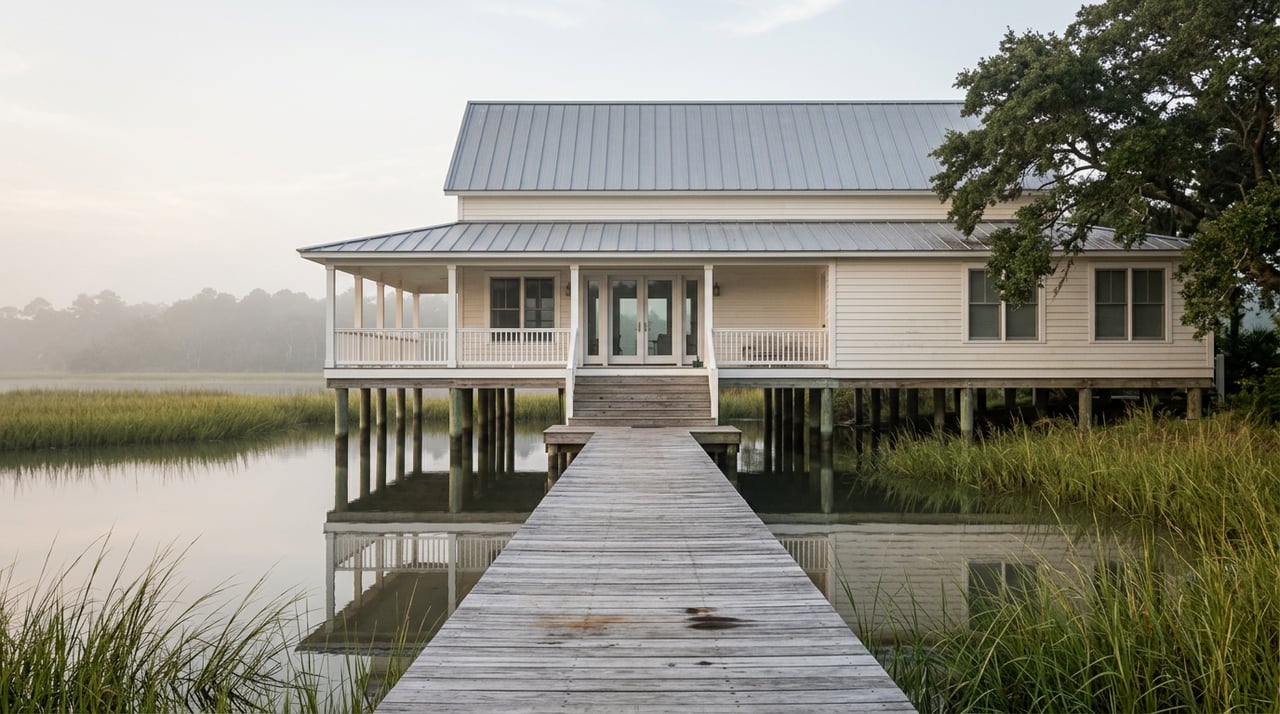
This is where the listing photo stops being useful. A dock in the picture tells you a dock exists today. It does not tell you what you are allowed to do with it once you own the property.
Private docks in North Carolina fall under the Coastal Area Management Act, and the general permit that covers most residential piers caps them at roughly 400 feet waterward of the normal high-water line, though that ceiling is rarely the real number. Established pier lengths nearby, water depth, and the width of the waterway can all push the allowable length shorter. Docking facilities also generally have to stay at least 15 feet from the property line extended into the water, which becomes a real constraint on narrow lots or shorelines that meet the water at an angle. A standard CAMA general permit for a residential dock runs $100 to $400 depending on the structure and typically takes two to four weeks to process, with storm-damage repairs to already-permitted structures moving faster, in the seven-to-ten-day range. Building anything new over state-owned submerged bottom also requires a separate easement from the State Property Office, priced by statute at $1,000 per acre of bottom covered, with a $500 minimum.
None of that shows up in a listing photo. It shows up in the permit history, which is exactly why older homes on Harkers Island deserve closer scrutiny than a quick walkthrough provides. A cottage that has been "moved, rebuilt, or expanded over time" may or may not have clean documentation behind its current dock, elevation, or additions. Before you write an offer on a property where boat access matters to how you plan to use it, ask for the permit history, not just the survey.
Most homes on Harkers Island run on private septic and well systems, and Carteret County Environmental Health handles the permitting, inspection, and approval for both. If you are buying a home on an existing system, the county's authorization process for connecting to or changing the use of that system typically requires a site plan, the original septic permit if it still exists, and confirmation that the system currently holds a valid operation permit. Even a complete application usually takes three to five business days for county review, and any building permit that touches the wastewater system may also require CAMA sign-off if the work falls near the shoreline.
A smaller number of parcels, historically concentrated in subdivisions like West Bay and Harkers Village, fall within the service area of the Harkers Island Sewer Company, a North Carolina public utility that has managed package-treatment plant equipment on the island for more than a decade as an alternative to individual septic systems. The utility describes itself as actively pursuing expansion, so the exact service boundary is worth confirming for any specific address rather than assumed from the subdivision name alone. Whether a given lot is on septic or served by that utility changes what you can add later. A future addition, garage, or extra bedroom on a septic lot depends on whatever capacity the original system was permitted for, which on a narrow waterfront parcel may leave very little room to expand. Knowing which system serves the property, and what its permitted capacity actually is, matters more here than it would on a typical subdivision lot with municipal sewer already in place.
If you are moving to Harkers Island from a market where homeowners insurance is a single annual bill, the coastal structure will feel unfamiliar. Standard homeowners insurance in North Carolina does not cover flood damage, and near the coast or inside a floodplain, lenders will typically require a separate flood policy. Windstorm and hail coverage is also commonly excluded from a standard homeowners policy in coastal counties and written instead through the North Carolina Insurance Underwriting Association, the state's Beach Plan, which carries its own separate deductible.
That means most owners on Harkers Island are pricing three policies, not one: a standard homeowners policy, a Beach Plan wind policy, and an NFIP flood policy. Flood coverage through the National Flood Insurance Program comes with a mandatory 30-day waiting period before it takes effect, and it cannot be purchased once a named storm is already being watched. With hurricane season running from June through the end of November, that waiting period is worth pricing into your closing timeline well before you are under contract, not after.
The median on Harkers Island will keep swinging wildly for the same reason it swung 70 percent in a single year: there simply are not enough transactions for it to behave like a market statistic anywhere else would. That is not a reason to distrust the island. It is a reason to stop reading the aggregate number and start reading the property in front of you.
Before you write an offer here, it helps to have answers to a short list of questions:
Those five answers, not the headline median, are what actually set your price on Harkers Island.
Is Harkers Island mostly on septic, or is public sewer available? Most of the island runs on private septic and well systems permitted through Carteret County Environmental Health. A smaller service area, historically centered on subdivisions like West Bay and Harkers Village, is served by the Harkers Island Sewer Company, a public utility offering package-treatment sewer as an alternative. The utility notes it is pursuing expansion, so confirm current service boundaries for any specific address.
How long does a CAMA dock permit actually take? A standard general permit for a residential dock typically takes two to four weeks from filing to issuance, with costs generally running $100 to $400 depending on the structure. Repairs to storm-damaged, already-permitted docks can move faster, often in seven to ten days.
Do I need flood insurance if my home isn't directly on the water? Standard homeowners insurance doesn't cover flood damage anywhere in North Carolina, and near the coast or inside a mapped floodplain, lenders will often require a separate flood policy regardless of exactly how close the parcel sits to the shoreline. Given the National Flood Insurance Program's 30-day waiting period, it's worth pricing that policy early in your due diligence rather than waiting until closer to closing.
If you're comparing specific parcels on Harkers Island and want to work through the permit history, the wastewater question, and the insurance stack before you write an offer, Michele Moffitt works this stretch of the Crystal Coast regularly and can help you read a property for what it will actually cost to own, not just what the listing says it costs to buy.
Stay up to date on the latest real estate trends.

What Coastal Homeowners and Buyers Need to Know

8 Things Every Crystal Coast Second-Home Owner Should Do Before Fall
Whether you're buying, selling, or investing, expect a seamless experience guided by market expertise, strong negotiation, and a commitment to making every step clear, confident, and stress-free.

Michele Moffitt
5420 Hwy 70 W Morehead City, NC 28557