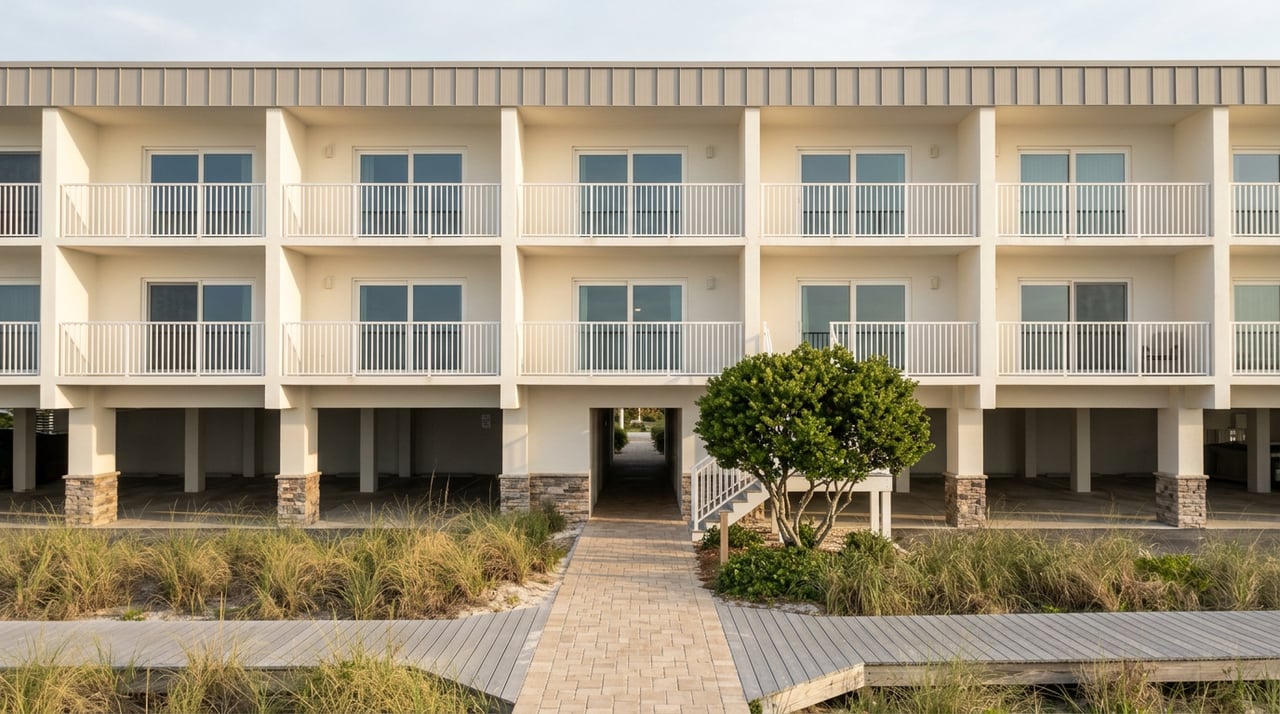
Why an Indian Beach Condo Closing Now Depends on the Building, Not Just the Buyer
September 17, 2026
September 17, 2026
Here is a question worth asking before you fall for the view: if your credit is strong, your down payment is ready, and your preapproval letter looks clean, what could still stop your loan from closing on a condo at Summer Winds or The Ocean Club?
The answer, as of this year, has less to do with you and more to do with paperwork your association may or may not have. On August 3, 2026, Fannie Mae and Freddie Mac retired the "limited review" lending path that let roughly 40 percent of condo purchases nationwide close with a lighter look at the building's finances. What replaced it is a full project review that digs into an association's reserves, insurance coverage, and litigation history before a single unit loan gets approved. For buyers shopping Indian Beach's oceanfront condo stock, that shift lands harder here than it does in most other coastal states, because North Carolina never required condo associations to keep the kind of paperwork this new standard expects.
For years, a buyer with solid financials could often get a condo loan approved on a streamlined basis, with lenders spending less time verifying the association's reserve funding or insurance history. That option is gone for most loans now.
| Old Limited Review | Current Full Project Review | |
|---|---|---|
| What lenders checked | Basic owner-occupancy ratio, minimal budget review | Complete budget, reserve study, insurance declarations, litigation history |
| Reserve funding standard | No specific threshold enforced | Rising to 15% of the annual budget by January 4, 2027 |
| Master policy deductible | Largely unregulated at the loan level | Capped at $50,000 per unit, effective July 1, 2026 |
| Who it affects | Roughly 40% of condo loans nationally used this path | Smaller developments of 10 units or fewer may still qualify for a waiver |
The practical effect is that a lender now needs documentation your association may never have been asked to produce. If the paperwork isn't there, the loan doesn't close, no matter how strong your own finances look.
Here is the part that makes Indian Beach a specific case rather than a generic one. Under the North Carolina Condominium Act, Chapter 47C, a developer must disclose reserve information in the public offering statement before the first unit sells. Once control passes to the homeowner-elected board, though, the law goes quiet. Nothing in the statute requires an established association to commission a reserve study or fund reserves at any particular level.
That puts North Carolina outside the roughly dozen states, including Florida, Colorado, and Virginia, that now mandate periodic reserve studies by law, several of them tightened directly in response to the 2021 collapse of Champlain Towers South in Surfside, Florida. A well-run association here might still commission studies as a matter of good governance. Plenty of others simply never have, because nothing has ever required them to.
The building's paperwork, not your bank statement, is now the variable most likely to slow or sink a condo closing on Bogue Banks.
Indian Beach's condo inventory spans a real range of ages, and that range matters more now than it did two years ago.
The Ocean Club, on Salter Path Road, is a good example of a building that has clearly been keeping up. Its ocean front and second row three-story buildings, 120 units built between 2001 and 2003, carry a 2026 regular assessment of $588 per month, which includes a $365 monthly master association fee, plus a 2025 insurance assessment of $2,926 charged separately. Those numbers tell a story on their own: insurance costs are being passed through in a way that shows up in the budget rather than getting absorbed quietly, which is exactly the kind of documentation a full project review wants to see.
Summer Winds, the largest community in the area at 211 units across three buildings on 18 oceanfront acres, has an extensive amenity package, heated indoor and outdoor pools, tennis and racquetball courts, a fitness center, and gated entry. A larger, older, amenity-heavy property like this carries more common-element exposure, which means more for a lender's project reviewer to check.
Grande Villas at Indian Beach, an eight-story building completed in 2008, is younger than The Ocean Club by several years, and its concrete and steel construction was built to a more recent code cycle. Two-bedroom units there have listed in the roughly $760,000 to $865,000 range. Age alone doesn't guarantee a clean reserve file, but a newer building typically has fewer deferred-maintenance surprises for a lender to flag.
Colony by the Sea, a smaller oceanfront community of 84 one- and two-bedroom units at Mile Marker 10, represents the kind of compact association where a single owner's voice in a board meeting carries more weight, for better or worse, when it comes to funding decisions.
None of this means one building is a better buy than another. It means the reserve study and the insurance declarations page are no longer optional reading. They are the documents that decide whether your loan closes on schedule.
The $50,000 per-unit cap on master policy deductibles, in effect since July 1, 2026, protects buyers from an association passing along an enormous uninsured loss after a storm. But it comes with a corresponding requirement on the owner's side. When a master policy carries a per-unit deductible, the individual owner is now required to carry their own HO-6 policy sized to cover the greater of 5 percent of the unit's coverage amount or $2,500.
That is a real number to run before you make an offer, not after. A $500,000 unit with a 5 percent deductible requirement means budgeting for $25,000 of personal coverage exposure on top of whatever your association's master policy handles. Ask for the current declarations page, not a summary, so you know exactly what deductible structure you are inheriting.
That fifth step matters most. A preapproval letter tells you what you can borrow. It does not tell you whether this particular building will let you borrow it.
Does this affect cash buyers? Not directly, since a cash purchase skips lender underwriting entirely. But a building that can't pass a full project review today may struggle to attract financed buyers when you eventually sell, which is worth factoring into resale expectations even if your own purchase is unaffected.
What if my target building has never had a reserve study? It is not automatically disqualifying, but it means your lender's underwriting will take longer while the association assembles documentation from scratch. Building in extra time before your closing date is the practical response.
Does a newer building guarantee an easier closing? No. Age helps with deferred maintenance, but a full project review also checks litigation history and current insurance coverage, both of which can affect a newer building just as easily as an older one.
Buying on the Crystal Coast has always meant looking past the view to the details that determine whether a home performs the way you expect it to. This year, that list includes a set of federal lending rules that quietly changed which buildings can close a loan at all. Knowing which documents to request, and which buildings already have them in order, is the kind of groundwork that separates a smooth closing from a stressful one.
If you are comparing condo communities on Bogue Banks and want a second set of eyes on reserve studies, insurance declarations, or how a specific building is likely to underwrite, Michele Moffitt can walk through the paperwork with you before you write an offer, not after.
Stay up to date on the latest real estate trends.

What Coastal Homeowners and Buyers Need to Know


8 Things Every Crystal Coast Second-Home Owner Should Do Before Fall
Whether you're buying, selling, or investing, expect a seamless experience guided by market expertise, strong negotiation, and a commitment to making every step clear, confident, and stress-free.

Michele Moffitt
5420 Hwy 70 W Morehead City, NC 28557